Protected
Selected work
This portfolio contains client work. Enter the password to continue.
User research while you sleep
- Product design
- AI
- Side project
Designed and built AnswerTime, an AI-powered async research tool end-to-end — parallelising user interviews, cutting per-interview cost by ~100× and eliminating scheduling overhead entirely.
A senior researcher costs £450–£600 per day. A six-week research project runs to around £27,000. Most teams don’t have that budget — and even when they do, the bottleneck is usually the researcher’s time, not the money.
I designed and built AnswerTime to fix this.
The problem
Three things make traditional user research expensive and slow:
- Cost; Senior researcher day rates are high and hard to compress.
- Capacity; Running interviews takes researchers away from synthesis, design, and everything else. You can’t do both at once.
- Timeline; Planning, recruiting, scheduling, running, and analysing a round of research takes weeks — by which time the question has often moved.
The root cause of all three is that traditional interviews are sequential and synchronous. One researcher, one participant, one conversation at a time.
What each role needed
- Reach more participants without sacrificing depth or context
- Cut scheduling and admin out of the research loop
- Get usable transcripts and themes ready for synthesis on day one
- Take part on their own time, not researchers' calendars
- Stay engaged in a low-stakes, conversational interview
- Skip account setup and complex tooling
- Get insight in days, not weeks
- Reduce per-project research cost by an order of magnitude
- Run rolling research between sprints, not only at major decision points
Approach
I treated AnswerTime as a real product from day one — discovery interviews with researchers, paper prototypes, working demos, and live testing with paying users. Learning to code as I went, I picked stacks that let me ship fast and iterate against feedback.
Stack: Chat interface adapted from ChatGPT via Vercel · data storage in Supabase · frontend, backend, user management and Stripe payments in Bubble.
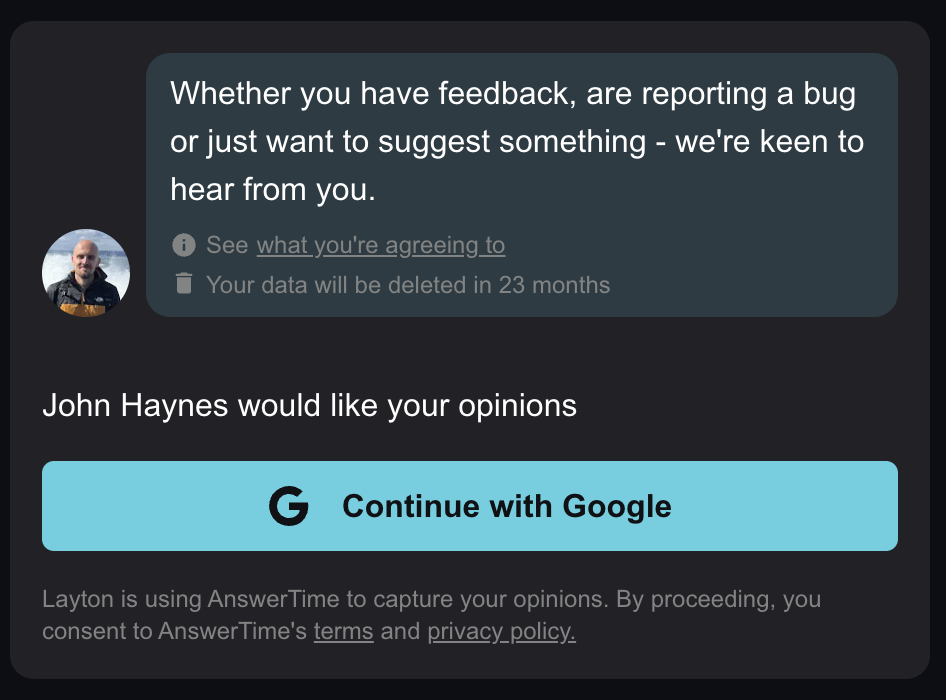
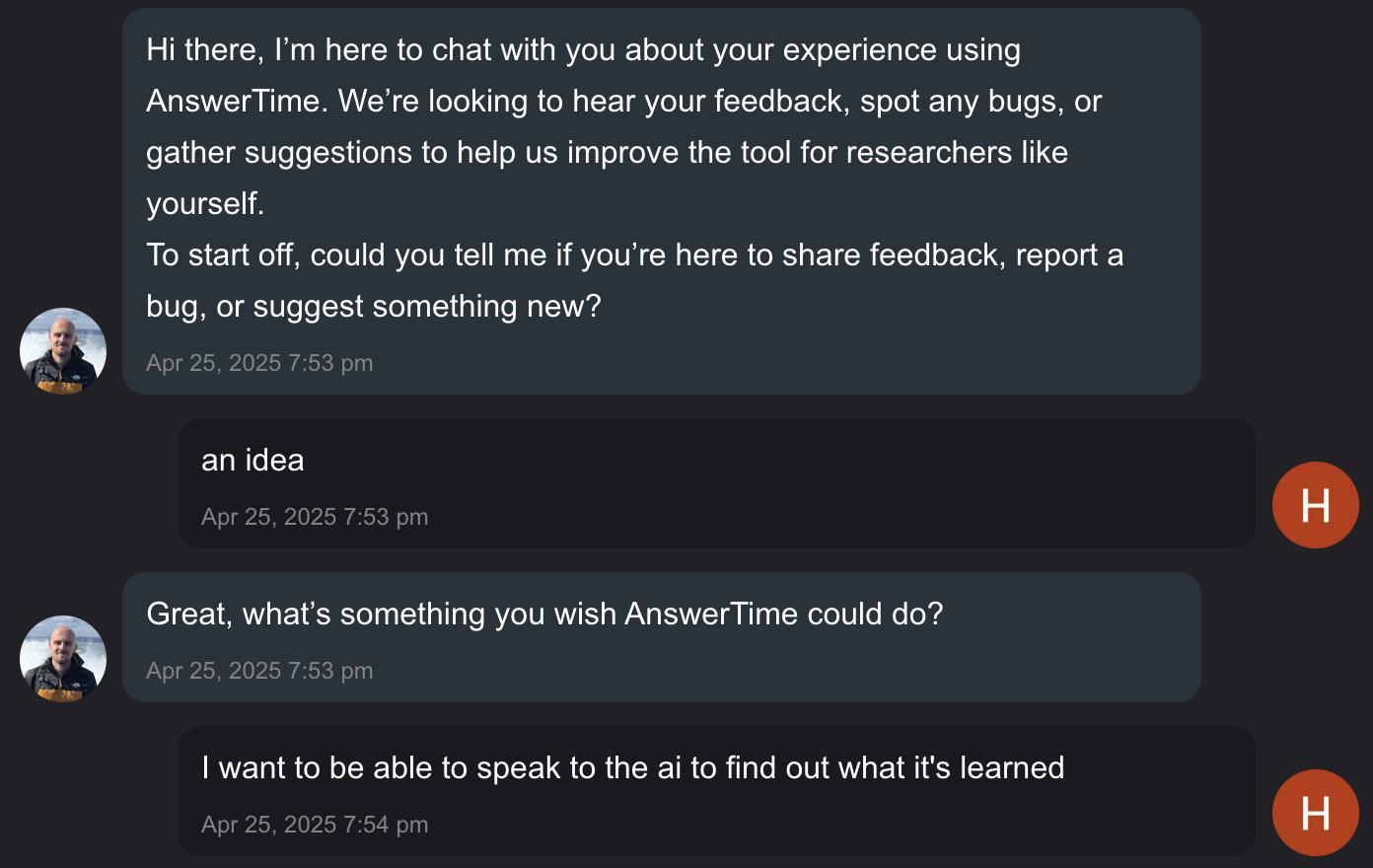
What I designed
Outcomes
What changed for each role
- One researcher can run many interviews in parallel
- No scheduling, recruitment or transcription overhead
- Themes ready for synthesis alongside the transcripts
- Engaged with the AI interviewer for longer than expected — sessions ran past planned duration
- Joined on their own time without booking calls or installing software
- Cut per-interview cost by ~100×
- Run rolling research between sprints, not only at major decision points